


Join me as I follow a thought through the act of creating.
Subject: a snippet of discovery-writing
Goal: watch how orientation forms
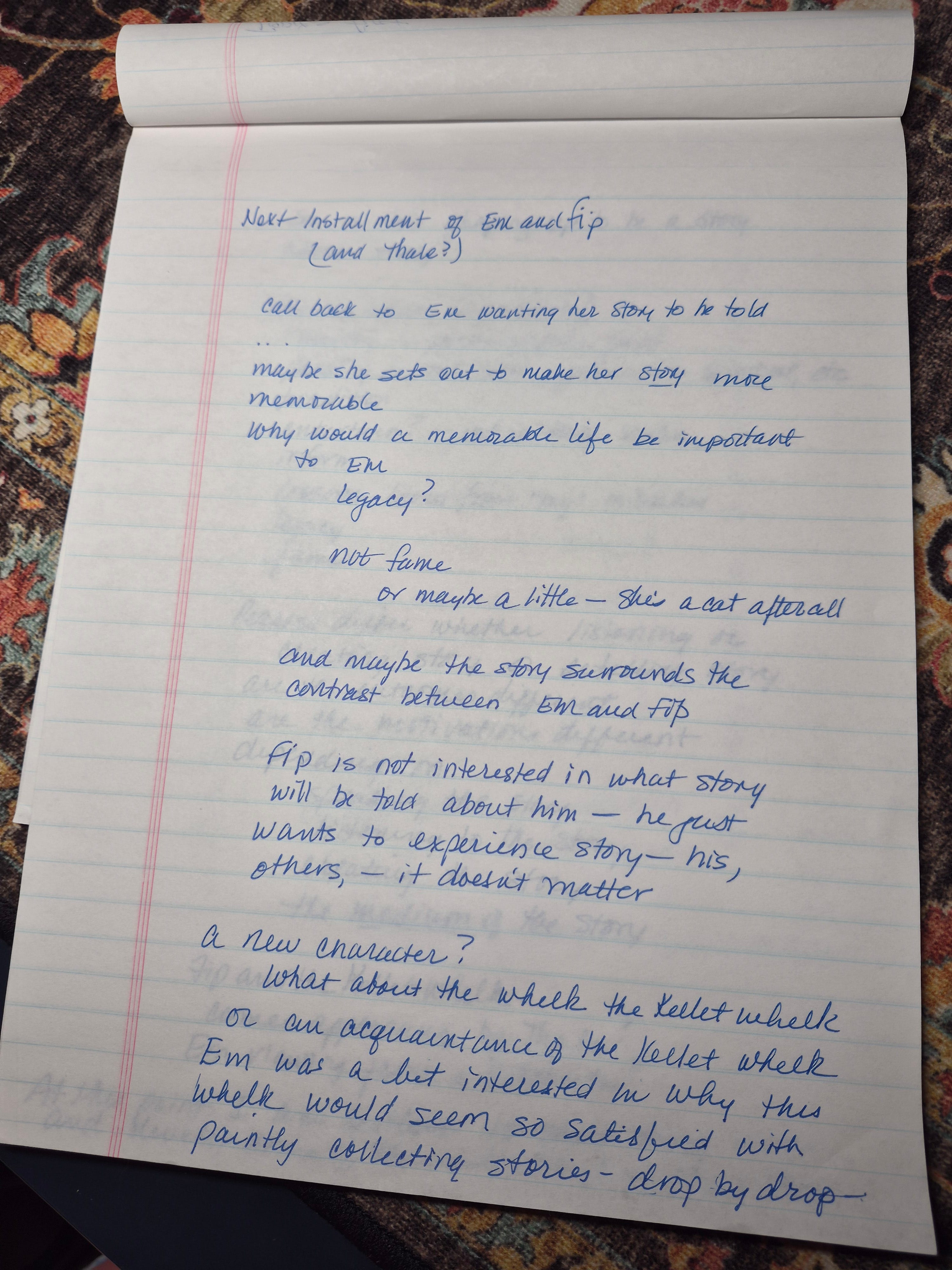
Transcribed Note (16 August 2026)
Next installment of Em and Fip
 (and Thale?)

callback to Em wanting her story to be told
…
maybe she sets out to make her story more memorable
why would a memorable life be important to EM
legacy?

not fame
 		or maybe a little—she’s a cat after all

and maybe the story surrounds the
contrast between Em and Fip

Fip is not interested in what story
will be told about him—he just
wants to experience story—his,
others,—it doesn’t matter

a new character?
 what about the whelk, the Kellet whelk?
or an acquaintance of the Kellet whelk?
Em was a bit interested in why this
whelk would seem so satisfied with
paintly (patiently) collecting stories—drop by drop—

so is this shaping up to be a story
about story?

Why are stories important?
memory—preserving the past
passing on important information, survival, etc.
tradition
entertain? –not in this sense
inform
lessons—learn from ‘my’ mistakes
legacy
fame

Reasons differ whether listening or
 creating story or retelling story
are the outcomes different?
are the motivations different?
depending on
 speaking the story?
 listening to the story?
 creating the story?
   the medium of the story

Fip and the Kellet whelk
cameo appearance by Thale?
Em viewing from a distance

At this point I am restless to share these ideas
and develop some of the understanding about story.
I find it fascinating to watch how the mind works.
Let’s have a look:
I started with an apparent story problem:
“callback to Em wanting her story to be told”
Then almost immediately interrogated the story premise:
“why would a memorable life be important to EM …”
The process began … without a decision.
A proposition caused a question.
The question destabilized the original thought.
The prize?—a more interesting possibility.
Enter Fip, toting a contrast:
“Fip is not interested in what story
will be told about him—he just
wants to experience story …”
The contrast is richer than Em’s desire alone.
Suddenly we are presented with two orientations toward story. Different. Neither wrong.
Em: What story will remain of me?
Fip: What story am I living?
If this distinction is wrapped around Em’s vanity and Fip’s seeming enlightenment, then we’re dancing with a moral lesson.
But I rather think that both desires offer something of value and something incomplete, reorienting us toward a philosophical fable. Delightful … and feeling more true to the original story from which these characters sprang.
It’s clear, however, that I am not satisfied with just the contrast of story meaning between Em and Fip because my attention quickly homes in on a third orientation—the whelk—the creature who patiently collects stories “drop by drop.”
Then … “so is this shaping up to be a story about story?”
This is a significant transition—moving from inventing a story to positioning myself for discovery—that is, asking: What question does the story legitimately want me to investigate?
Immediately thereafter, my language changes.
I move away from plotting to generating a constellation with star-points including memory, preservation, survival, tradition, information, lessons, legacy, and fame.
And then I find my wonder-hole, triggered by this generative thought:
“are the outcomes different?
are the motivations different?
depending on
speaking the story?
listening to the story?
creating the story?”
Why stories are important is too large—and perhaps too familiar—to guide this intimate journey of Em and Fip.
Now we shine the light of focus on a stranger question:
Does a story become a different thing depending upon our relationship to it?
And I think to myself … “What a wonderful world” to explore through these little creatures, rather than through an essay or serious philosophical discourse.
Voilà!
I captured a glimpse of one movement of my process—a path I can trace through this particular specimen:
memory → attention → question → contrast → association → new character →
abstraction → differentiation → deeper question
This path approaches something I am currently developing—a hypothesis that attention, cognition, and language interact to orient us toward discovery when we write.
Now, talk about a work in progress! I’m still hypothesizing. For now, I can only offer glimpses through these field notes.
And you thought when you write, you’re just writing. 😊
Perhaps in my next field note, we can examine the final line of my raw process note:
“At this point I am restless to share these ideas and develop some of the understanding about story.”
That may reveal something interesting about creative writing: discovery can generate an urge toward interlocution.

What about you—
have you wandered into your own cognitive processes when you write?
Were you surprised by what you found?
This is really fascinating, both the exploratory developmental writing and then your retread of that path, analyzing your steps. I don't know that I've ever gone that deep into my thought process before, at least not in such an intentional way. When exploratory writing leads me to a new revelation or way of thinking, it's usually the jumping off point for the next creative action--maybe I'm just impatient or impulsive that way! 🤣
I say that, but then as I think about it more... how many of my weekly comics are about the creative process and experience? 🤔😅✨
The concept this is most reminding me of, appropriately or not, is narrative design in video games. Narrative designers consider 2 different stories: the game story (the plot, characters, dialogue, etc) and the player story (the experience the player has during the game). I think there might be a similar concept in creativity itself, for every artist has the story they make (or painting, or craft, or whatever output) and the story of the making. And I think there's a place for those to overlap, because they are intertwined. ✨