


Were the first astronomers actually unsung poets?
I say they were sky-poets.
They were the earliest watchers of the night sky—the ones who recorded celestial events not only for practical reasons, but because the heavens stirred something in them. The ones who may have written nothing in meter yet sensed the sky in ways that border on story.
Sky-poets.
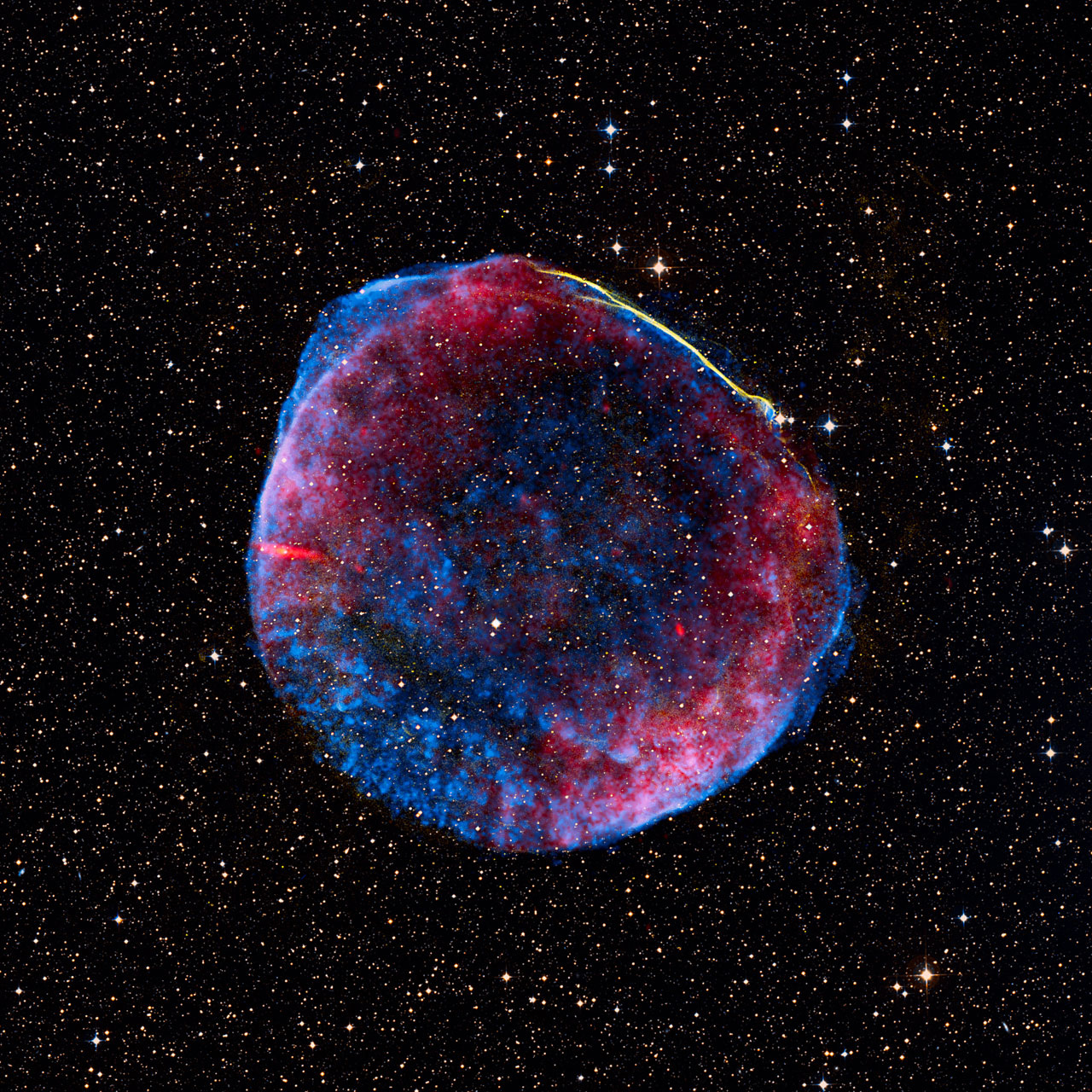
A thousand years ago, the brightest stellar explosion ever witnessed by humans lit the sky. Ibn Sīnā saw it.
Ibn Sīnā (AD 980-1037)—known to the Latin World as Avicenna—was a Persian scholar of physics, astronomy, and meteorology. Not a poet, but someone whose science kept slipping into metaphor, as if the sky demanded it.
… a star appeared among the stars… it began to throw out sparks … the form of a beard or an animal with horns …
Ibn Sīnā in Kitāb al-Shifā (Book of Healing) as translated by Madkūr et al. (1965)
How might you have described a star so bright it cast shadows at night?
More Arabic Records of SN 1006
Among the sky-poets of 1006, the most detailed account comes from the Egyptian astronomer Ali ibn Riḍwān, observing from Cairo. He was in his late twenties—a physician, astrologer, and meticulous sky-watcher—when the “new star” appeared.
His description is astonishingly precise:
“A large circular body, slightly oblong… its light more yellow than white, and its brilliance so intense that it overwhelmed the light of the Moon. Its rays were like the rays of the Sun.”
This is not the language of myth or omen.
This is the language of someone trying to wrangle an impossible brightness into human words. And that effort—the mixture of measurement, metaphor, and sheer visual astonishment—is exactly what reveals the sky-poet’s presence.
Ibn Riḍwān was not writing poetry, but his attention was devoted in the same way: to seeing clearly, and then pushing language to meet the sky.
The Chinese Guest Star
Far to the east, Chinese astronomers recorded the same explosion in a different vocabulary—one that blended precision with a cosmology rooted in metaphor. They called it a guest star (kè xīng, 客星), a term reserved for any sudden visitor to the sky.
In their worldview, the heavens were a kind of celestial household, each star with an appointed place; anything new, bright, or uninvited arrived as a guest, demanding attention.
Their record of SN 1006 is crisp: “On the night of May 1, 1006, a star ‘as large as half the Moon’ appeared in the constellation Di (part of modern Lupus). It shone ’with rays in all four directions,’ flickered night after night, and remained visible for nearly three years.”
This is observational discipline at its finest—careful tracking, positional notes, sustained watching.
And yet, even here, the sky-poet’s touch shows through.
To name a star a guest is already to tell a story. It imagines the cosmos as a place with thresholds and arrivals, with visitors who flare briefly into view and then depart.
The Chinese observers did not write poetry, but their astronomy carried a narrative instinct: a desire to understand not just what the heavens did, but what kind of presence they were.
The Japanese Chronicles
In Japan, the same star blazed into the historical record, but the tone shifts—less systematic than the Chinese logs, more visceral than the Arabic analyses. Court chronicles describe it simply as a “very bright star,” a “burning star of extraordinary brilliance,” sometimes “red and scintillating.”
The entries are sparse, but their immediacy gives them a human pulse. Someone looked up, was struck by what they saw, and wrote it down with the urgency of witness. There is no attempt to measure, to classify, or to reason through the phenomenon.
The Japanese accounts read like quick notations of awe—brief flashes of language catching the afterimage of a blazing night. And in that directness, there is another form of sky-poetry: the impulse to name astonishment before it fades.
The European Monastic Witnesses
Far to the west, in the monastic world of medieval Europe, SN 1006 entered the record with a voice different from any other—a blend of awe, confusion, and quiet dread.
The most vivid account comes from the monastery at St. Gallen in Switzerland, where a scribe wrote that a “new star of extraordinary brightness” appeared, so fierce that “the sky seemed on fire.”
Some chronicles claim it cast shadows at night—a detail modern astronomers consider entirely plausible given the star’s intensity.
These were not astronomers in the formal sense. They had no instruments, no established vocabulary for sudden celestial change, and little sense of the sky as anything other than a divine text.
And so their language becomes image-driven, elemental: fire, brilliance, radiance, fear. What they lacked in measurement, they compensated for with metaphor.
Their accounts are sky-poetry of a different kind—born not from discipline or narrative curiosity, but from the instinct to shape uncertainty into meaning.
Across these voices—Arabic, Chinese, Japanese, European—the same event is refracted into different shapes: sparks, rays, fire, brilliance, a guest star, a fearful omen. Each description is anchored in its culture, yet all of them circle the same truth. Something unimaginably bright tore into human awareness in the spring of 1006.
What none of these sky-poets could have known is what we now take for granted, that this “new star” was not new at all, but ancient light arriving from a star that had destroyed itself seven thousand years earlier.
And the moment that light reached Earth, it pulled watchers everywhere into the same act of astonished seeing.
Only now—through telescopes, spectra, and X-ray vistas—can we name what they witnessed. A Type Ia supernova, the most luminous stellar explosion recorded in human history.
The sky-poets wrote its appearance; modern astrophysics reveals its cause.
What the Sky-Poets Actually Saw
What shone above them in 1006 was the death of a star—specifically a Type Ia supernova, the catastrophic detonation of a white dwarf.
These stars are the stripped-down cores of once-sunlike suns, dense enough that a teaspoon of their matter would outweigh a mountain. But when a white dwarf siphons too much material from a companion star, it reaches a fatal threshold—the moment gravity and pressure can no longer balance.
And then it happens.
The star ignites in a thermonuclear flash so violent it tears itself apart from the inside out. For a few weeks or months, that explosion can outshine an entire galaxy.
SN 1006 was one of these—likely the brightest stellar event any human eyes have ever seen. Bright enough to cast shadows. Bright enough to be noted across continents. Bright enough that even today, its shockwave is still racing outward through space.
Modern telescopes reveal the remnant as a vast, expanding shell—filaments of gas, dust, and ionized plasma, glowing in X-rays and radio waves. What looks now like a delicate ring a few dozen light-years wide is, in truth, the lingering echo of unimaginable violence, still pushing against the interstellar medium more than a millennium later.
The ancient watchers saw only the flash, but their words—sparks, rays, fire, brilliance—were uncannily faithful to the physics we now understand. Without instruments, equations, or models, they captured what mattered most: the overwhelming presence of a star in its final act, writing itself across the night.
Why It Matters
Why linger over these scattered descriptions of a star that flared and faded a thousand years ago?
Because taken together, they reveal something essential about us.
When faced with the vastness of the sky, human beings reach for meaning with whatever tools they have. Some reached for measurement, some for metaphor, some for prayer—but all of them reached.
And this reaching is the thread that binds them.
It shows that astronomy didn’t begin as a cold, numerical discipline; it began as a human response to wonder. Before telescopes, before physics, before we knew that stars lived and died, people looked up and tried to translate the sky into language.
They were not poets in the formal sense, but they were doing the poet’s work— noticing, naming, shaping experience into something sharable.
Their records of SN 1006 matter because they capture the exact moment when the universe intruded into human life with such force that cultures everywhere felt compelled to write it down.
They matter because they show that science and story were not always separate paths—they used to be one trail, walked by people who paid close attention to the world and trusted their senses enough to describe what they saw.
And they matter because the lineage they began didn’t end. The instinct that moved Ibn Sīnā, Ali ibn Riḍwān, the Chinese court astronomers, the Japanese chroniclers, and the monks of St. Gallen is still alive today—in scientists, writers, dreamers, and those who continue to watch the night sky with both rigor and wonder.
Which brings us to the one person who made that lineage unmistakable.
The Modern Sky-Poet — Rebecca Elson
If the watchers of 1006 were sky-poets in practice, Rebecca Elson was one in full recognition.
An astronomer trained in the hardest edges of astrophysics—star clusters, galactic structure, dark matter—she also wrote poetry that refused to separate science from wonder. In her hands, the language of the cosmos belonged as much to metaphor as to measurement.
Elson understood what the ancient observers intuited. To study the sky is to stand at the threshold between knowledge and mystery.
Her poems return again and again to the feeling that science doesn’t diminish the universe’s strangeness; it sharpens it. She wrote from that place of double vision—one eye in the lab, one eye in the stars—a vantage point the sky-poets of 1006 would have recognized immediately.
In one of her most haunting reflections, she writes:
“Facts are only as interesting
as the possibilities they open
in our imagination.”
This is the hinge between their world and ours.
The sky-poets of the past opened possibilities through the metaphors available to them—sparks, horns, fire, guests. Elson opens them through modern physics, but the impulse is unchanged.
To look up is to be moved. To be moved is to seek language. To seek language is to confess that the universe exceeds us, and yet invites us in.
Elson didn’t just study starlight; she listened to it. And in doing so, she completed the circle begun by those watchers in 1006—the scholars, chroniclers, and anonymous eyes who tried, each in their own way, to give the sky a voice.
A thousand years ago, a star exploded and its light swept across the world, pulling countless people into the same act of astonished seeing.
They wrote what they could, in the languages they had, leaving traces that still shimmer through the historical record. Today, we understand the physics they could not, but the instinct remains the same.
We are still watching. Still wondering. Still reaching for words that can hold even a fraction of what the sky gives us.
Perhaps that is the quiet truth running through this whole lineage: that the first astronomers were poets, and the last ones will be, too. Because the universe keeps giving us more than facts to measure.
It keeps giving us something to feel, and the impossible task of trying to say it.
And now … my own impossible task of trying to say it:
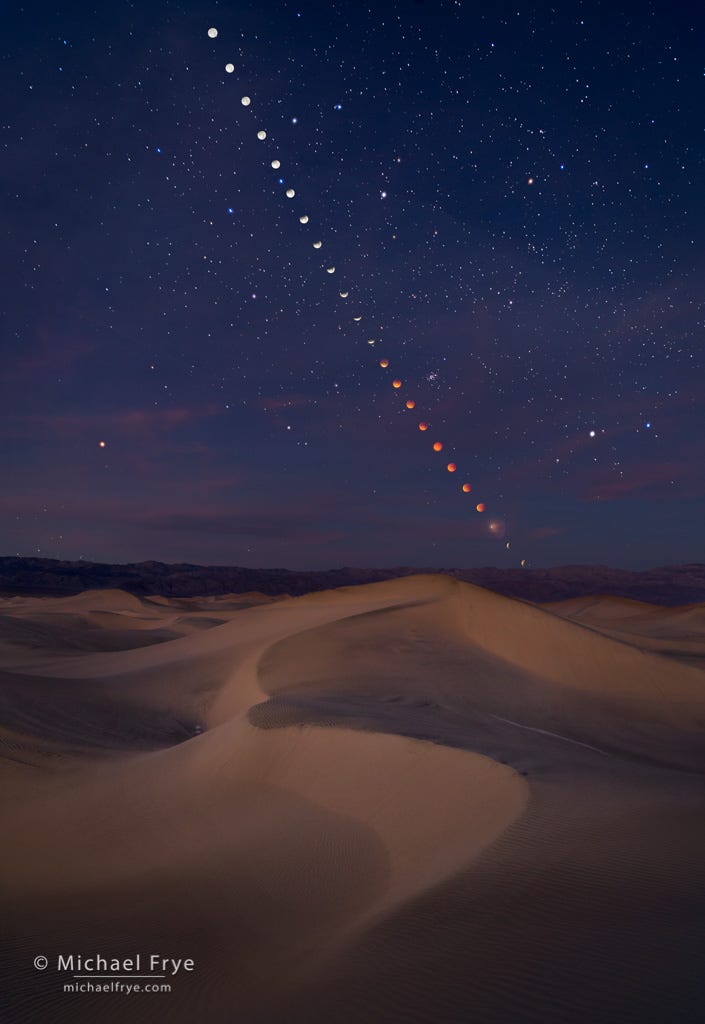
Eclipse
by jlynn
Grown-up voices hushed around the fire.
It was my father who named the beast—
Eclipse—
a word that landed wrong in a child’s ear.
Terror softened into curiosity
by the shifting sands of the dunes.
Over those dunes the beast would come,
but Death Valley would not take me tonight.
Though the beast called Eclipse just might.
I fought to free myself from the sleeping bag …
my god, the stars—so many—
until the beast.
Blood-red moon.
A shadow beginning to gnaw at its fullness.
What creature eats a sky, I wondered.
Who would save the moon?
Grown-up voices hushed again.
My father’s voice heaved with awe
as he rose to meet the beast.
I trembled, stood, and raised a hand—
to the sky? to the beast? I do not recall.
I remember only the awe,
and how I wondered still
who would save the moon.
Next week, Essay 2: Dragons in the Sky: When Celestial Events Become Myth
Intro to the series can be found here: The Star Archive - How Poetry Saved the Sky

This is wonderful. I love the sense of wonder that comes through in your writing as you describe how wonder shaped the records of the supernova!
I love the idea of sky-poets. Thank you for writing this and sharing your Sky-poetry.