


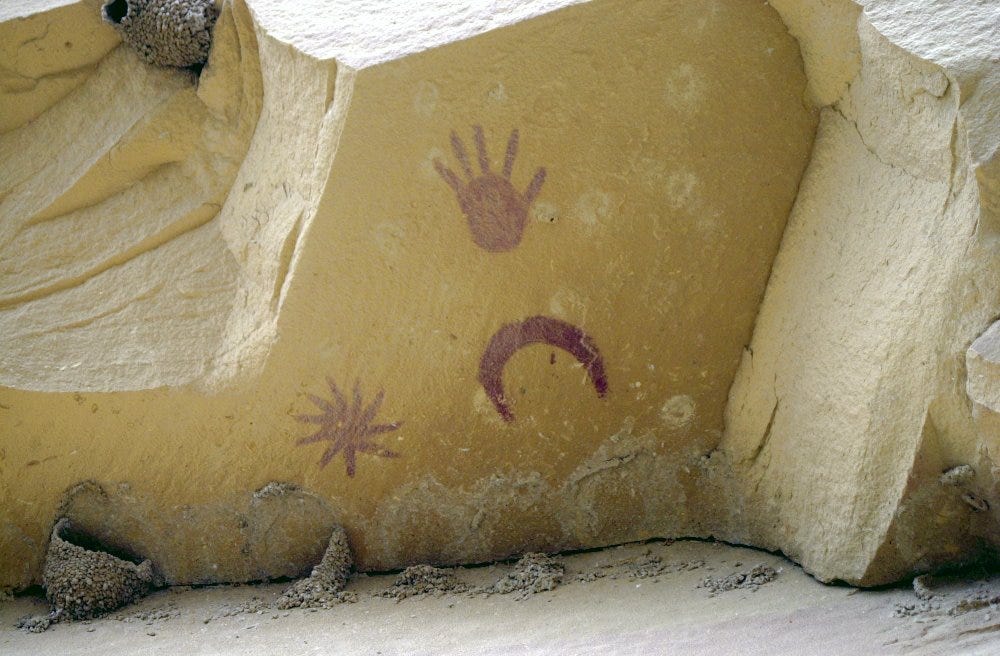
Stop
and wonder.
Stop
and hear.
The sky is speaking.
Stop
and revere
the crescent moon
drawn
to the birth of a new light.

Who speaks?
Who listens
enough to paint the sky’s words?

Those who listened long enough.

They watched the skies.
They spoke.
They listened.

All these centuries later,
did we hear

the Crab’s claim?
What I have just written is a poem, but it is not the kind of poetry I am here to describe. It is what remains when we try to meet a way of knowing that predates language itself. The people I turn to next did not write poems about the sky. They listened to it, paced it, marked it—with stone and shadow.
Long before telescopes, before calendars bound in paper, before the sky was rendered into numbers, there were places built to observe. One of those places lies in the high desert of present-day New Mexico.
Chaco Canyon: When the Sky Was Architecture
Chaco Canyon is the center of an ancient world—the ceremonial heart of an Ancestral Puebloan culture that flourished between roughly 850 and 1250 CE. It was not merely a place to live, but a place to watch.
A sacred place shaped by attention.
A sacred place still today.
The sandstone walls and open plazas of Chaco Canyon reveal a culture of sophisticated sky-watchers. This attentiveness is evident not only in petroglyphs and pictographs, but in the deliberate orientation of Great Houses and kivas—structures aligned with cardinal directions and the rising and setting of the sun on solstices and equinoxes.
Meaning was placed into pattern.
Time was held in return.
The Ancestral Puebloans did not write about the sky. They built it.
They carved their cosmology into stone. Massive buildings align with celestial cycles. Long sightlines stretch toward horizon markers where light performs its quiet choreography—returning again and again, year after year.
This was not decoration.
It was practice.
Stone remembered what language did not need to say.
Some visual marks remain: spirals pecked into rock, handprints pressed into pigment, starburst shapes whose meaning we approach with humility. Whether these images commemorate daily cycles or extraordinary events, we cannot say with certainty. What we can say is that this was a culture prepared to notice—to observe without haste, to mark absence and return, to trust repetition as knowledge.
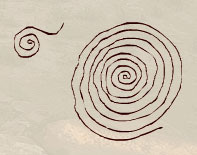
Listening, here, was a way of knowing.
And that may be the most important inheritance Chaco leaves us—not proof of a particular sighting or event, but evidence of sustained attention. A discipline of watching. A willingness to wait until meaning emerged on its own terms.
We are trained to look for evidence where there are answers. Chaco asks us to look for answers where there is attention. Before knowledge was explained, it was practiced. Before it was written, it was watched. What remains is not a record of what was seen, but proof that someone was listening.
Whether these ancient sky-watchers saw a supernova matters less than the fact that they were prepared to notice.
They built places where noticing could happen.
They returned.
They watched.
And for a long while, that was enough.
If you write poetry without words, I’d love to see … to watch.
This essay is part of the Star Archive Series.
Intro: The Star Archive: How Poetry Saved the Sky
Essay 1: The First Astronomers Were Poets
Essay 2: Dragons in the Sky: When Celestial Events Become Myth
Next time …
We endeavor to examine what counts as evidence when poetry becomes architecture.

JL, you’ve basically convinced me that the ancient Chaco sky-watchers were just quiet overachievers doing cosmic journaling before it was cool.
No words, no captions — just, “I saw a supernova, here’s my rock-post, enjoy.”
And honestly? I adore the idea that the universe has been side-eyeing us for centuries going,
“Hello? I’ve been speaking. Pay attention.”
Your piece feels like someone gently taking my chin and tilting it toward the sky.
Which… rude, but also thank you.
All of it is poetry - the attention, the wonder, the integration of understanding into matter and the reverence. Beautiful ☀️