

The Crab’s Claim: Evidence After Attention
Essay #4 in the Star Archive Series

From Listening to Measurement
What begins as wonder does not disappear. It learns to count.
Listening, practiced long enough, sharpens into precision. Attention repeated across generations begins to leave testable marks.
If the first question is how humans learned to hear the sky, the next must be how that listening became reliable.
At some point, wonder organizes itself. Light is no longer only received; it is anticipated. Shadow no longer surprises; it returns on schedule.
What we begin to see in places like Chaco Canyon is not poetry abandoned for data, but poetry hardened into form—attention made durable enough to be checked against time itself.
The Sun Dagger: When Light Became a Tool
Petroglyphs and pictographs are plentiful throughout Chaco Canyon—some of which have been plausibly interpreted as records of solar and celestial observation. Sun Dagger, atop Fajada Butte, is perhaps the most prominent.
Fajada Butte towers (135 m/440 feet) above the floor of Chaco Canyon in present-day New Mexico. Was it an ancient observatory?
The idea cannot be lightly dismissed.
Near the top of the butte, on a cliff face near its summit, three large sandstone slabs are positioned in front of a shaded cliff wall holding pecked spiral petroglyphs. Whether the slabs were placed intentionally or are a result of fortuitous rock fall matters little.
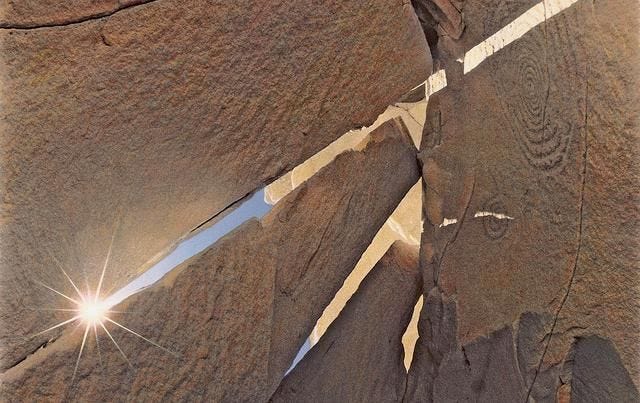
What matters more is that ancient sky-watchers noticed.
And they pecked spirals into the underlying cliff wall in a manner that allowed shadow and light to form a precise calendar marking solstices, equinoxes, and even lunar cycles.
Because they watched.
They noticed.
The spirals are not symbolic language as much as they are optical engineering.
The patterns of light and shadow that fell through the space between slabs has been studied long enough to reach agreement that these spiral petroglyphs are less art and more purpose. And remarkably precise.
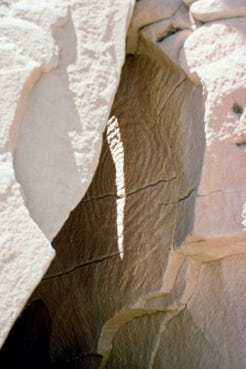
On the summer solstice, a thin beam of light (the “dagger”) would bisect the larger of the two spirals.
At the winter solstice, two daggers would embrace the sides of the large spiral.
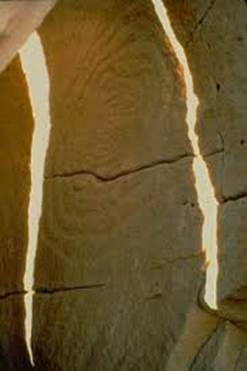
and other patterns would mark the equinoxes.
Check out this Exploratorium interactive Sun Dagger demonstration.
Note: Due to a shift of the leaning sandstone slabs, possibly from too many visitors, the sun and moon no longer cast shadow and light so precisely as they used to, and access to the site is now severely restricted—a good thing really.
One of the things that adds to fascination with the Sun Dagger at Fajada Butte is the ancient sky-watchers precisely recording both solar and lunar events.
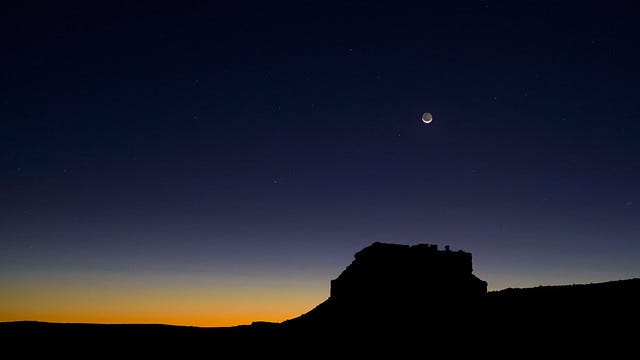
The same two spiral petroglyphs were situated to also track the 18.6-year lunar standstill cycle. That’s when the Moon reaches its most extreme northern and southern rising/setting points, causing it to appear much higher or lower than usual.
In this regard, Fajada Butte was a rare site for astronomical observances by the ancients.
No writing necessary. The poetry was in the noticing … the attention.
Light itself became the recording medium.
Attention was the language.
Prepared to Notice: The Question of SN 1054
Let us return now to the ‘Crab’s Claim.’
We’ve now seen that the Ancestral Puebloans carved their cosmic worldview in stone. They created a cosmic calendar marked by cardinal directions and specific celestial events. But was one of those events the massive supernova responsible for creating Messier 1—the Crab Nebula?
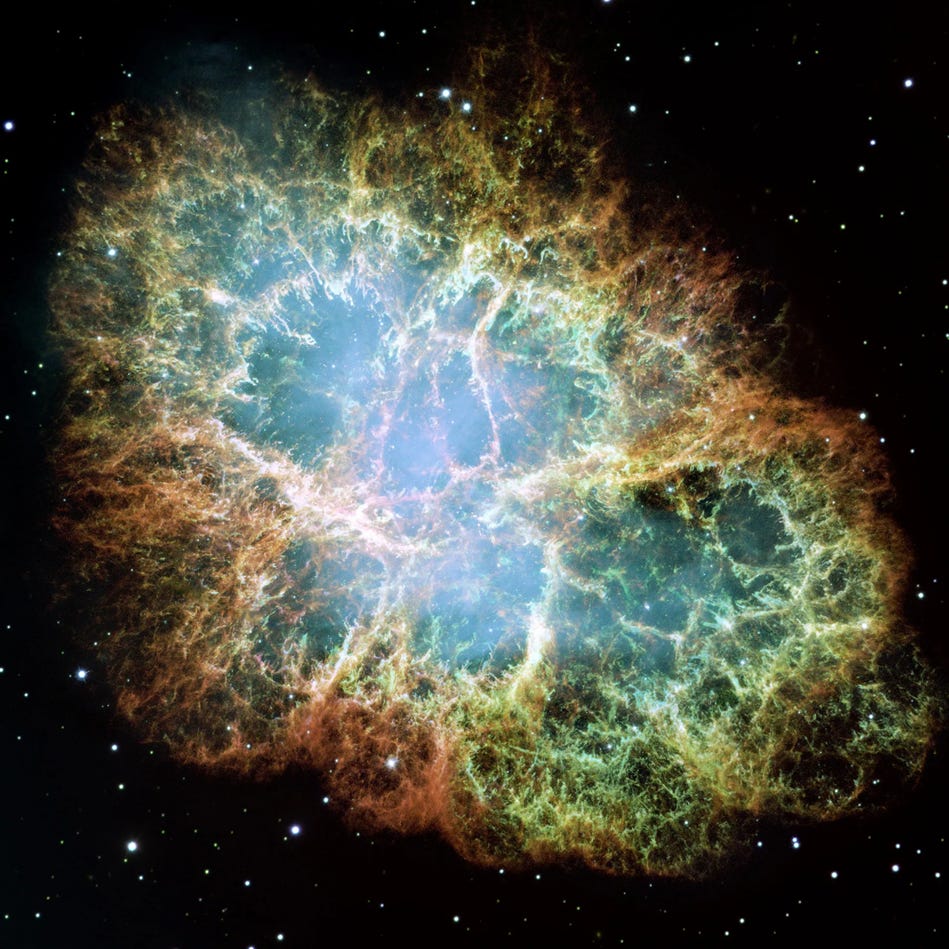
This celestial event was witnessed by many cultures, and particularly noted by Chinese astronomers as a “guest star,” which remained visible for weeks in daylight.
The Chinese astronomers recorded the first appearance of SN 1054 on 04 July 1054. Further, calculations show the moon was a waning crescent at that time, just entering its first quarter, and was very close to the supernova’s position in the sky.
Did the ancient sky-watchers of Chaco Canyon also witness this colossal explosion on the other side of the world?
Is that what we see in this pictograph?
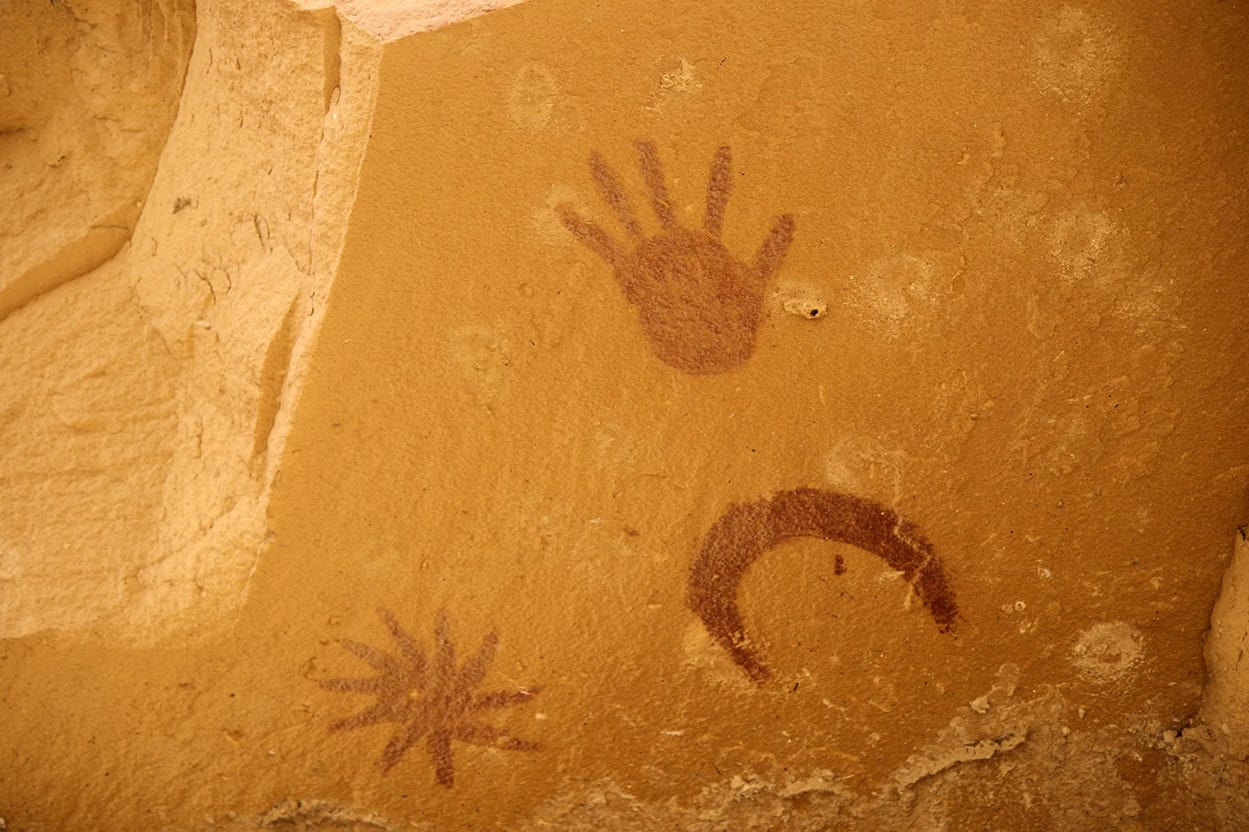
The ten-point star might suggest an explosion or birth of a star. The crescent moon may provide a reference for time of observance.
And the handprint … some say a common sign of a sacred site, or as reported by Brandon Hayes, “a widespread motif in Ancestral Puebloan rock art often thought to mean “we are/were here.”
We also know that the prominent Chaco Canyon pictograph is oriented toward the east, which would align with the supernova’s predawn appearance.
Regardless of the right time and the right place, we can’t know if this pictograph is another record of SN 1054.
But let’s consider one more image—a broader view of the previous pictograph.
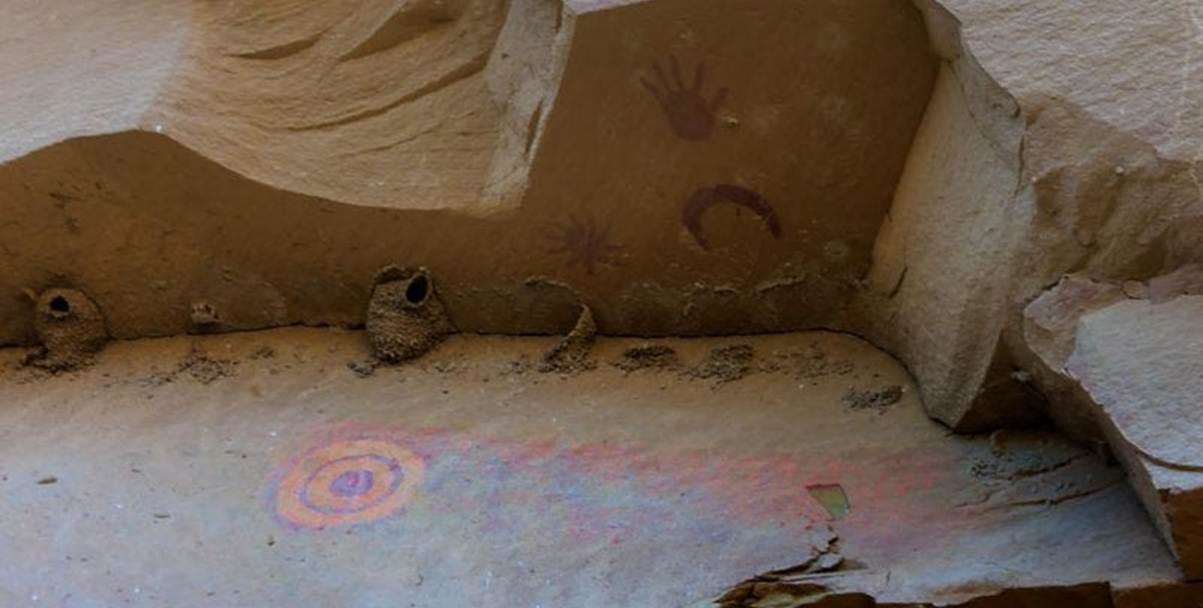
Photograph by Rob Pettengill using color saturation to illuminate the more severely faded pictograph on an adjacent wall.
Note the enhanced colored portion of the photograph—the solid circle surrounded by two rings and a trail of red widening to the right. Compare it with the picture of Halley’s comet below.
Records indicate the comet passed in view of Chaco Canyon in 1066—not long after SN 1054.
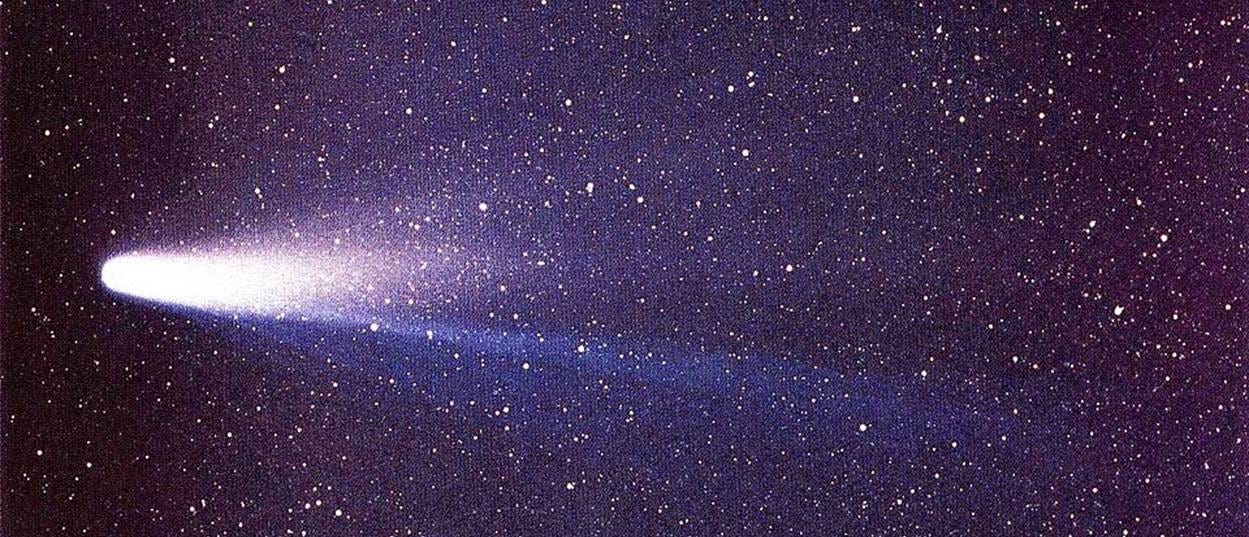
Coincidence or circumstantial evidence?

It’s not just the these sky-watchers randomly took note of the sky. It’s that they did so with regularity and intent. Patterned.
Poetry—not in a textual sense, but in a patterned observation sense?
We not only had ancient sky-watchers who recorded sky knowledge in stone, but there were also horizon walkers or Sky Pacers who held sky knowledge in their bodies.
Sky Pacers: Learning the Sky By Moving With It
The Chaco pictograph gives us one way ancient sky-watchers remembered the heavens—by carving a moment into stone. But not all knowledge was held in walls or spirals.
Some of the oldest astronomy on earth left no mark at all. It lived in bodies, in footsteps retraced across the same horizons for generations. Before there were observatories, before there were calendars, there were people who learned the sky by moving with it.
These were the Sky Pacers—observers who walked the world in rhythm with the sun and moon, letting repetition carve meaning deeper than any tool could.
Sky Pacers Across Cultures: When the Body Was the First Observatory
Sky Pacing was never a single tradition. It arose wherever humans lived close enough to the land that the horizon itself became a teaching tool. What ties these practices together is not a shared mythology, but a shared method: returning to the same place, again and again, until the movement of the heavens lived inside the observer.
Below are three examples from very different cultures—chosen not to claim equivalence, but to show how widespread this embodied astronomy once was.
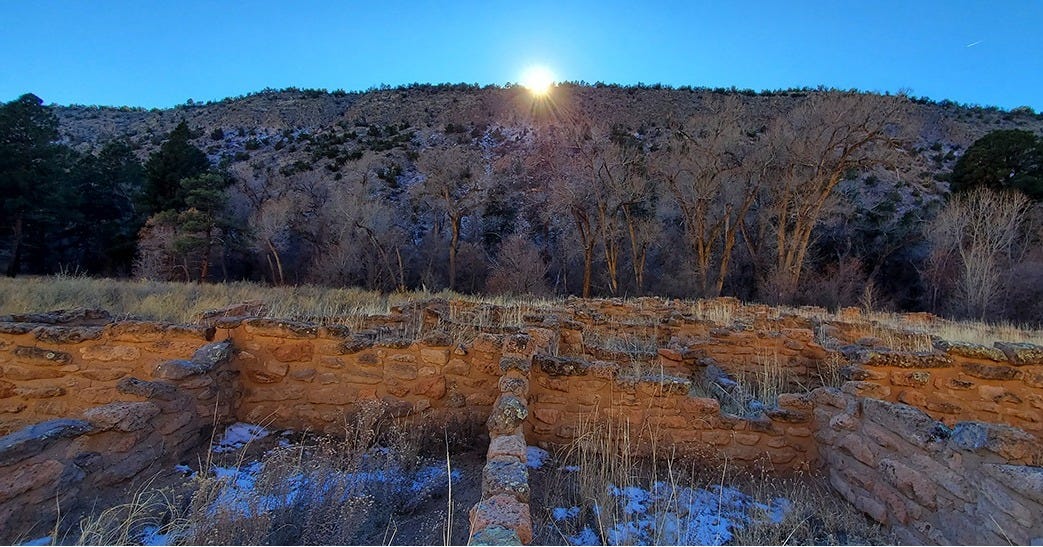
1. Puebloan and Greater Southwest Horizon Practices
Even beyond Chaco Canyon, many ancestral communities of the American Southwest relied on horizon tracking long before they built formal solar markers.
Seasonal observers would:
return to the same notch in a mesa to watch the sun rise
note where the moon set relative to ridgelines
walk the same paths to confirm planting, hunting, and ceremonial timings
No instruments.
No diagrams.
Just repetition, refined over generations until the body itself carried the calendar.
This practice didn’t compete with architectural observatories like the Sun Dagger—it preceded them. Stone made the knowledge durable; pacing made it living.
2. Aboriginal Australian Songline Walkers
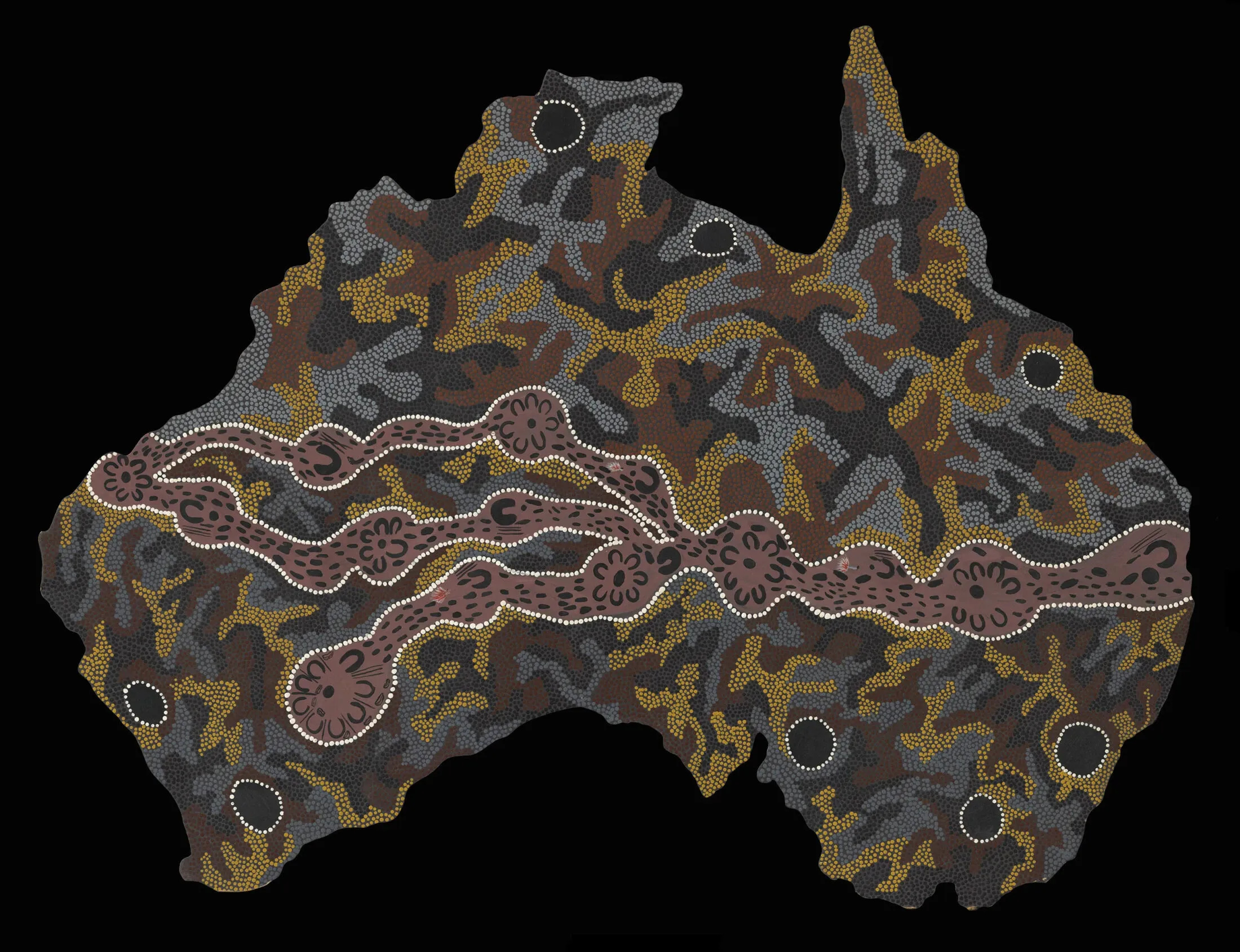
In Australia, astronomical knowledge traveled by footstep and melody. Songline custodians walked vast routes where the land, sky, and story were inseparable. While each community’s knowledge is distinct—and much is sacred or restricted—what can be said generally is this:
A person moving through the landscape was also moving through the sky.
Each rise and dip in the land mirrored a star-path
The timing of ceremonies aligned with heliacal risings
Orientation depended on knowing where celestial bodies rose and set along the horizon
This was not symbolic. It was navigation, memory, cosmology, and astronomy at once.
If Chaco teaches us how stone remembers astronomical cycles, songline traditions show us how the body remembers without stone at all.
3. Polynesian Navigators and the Canoe-Horizon
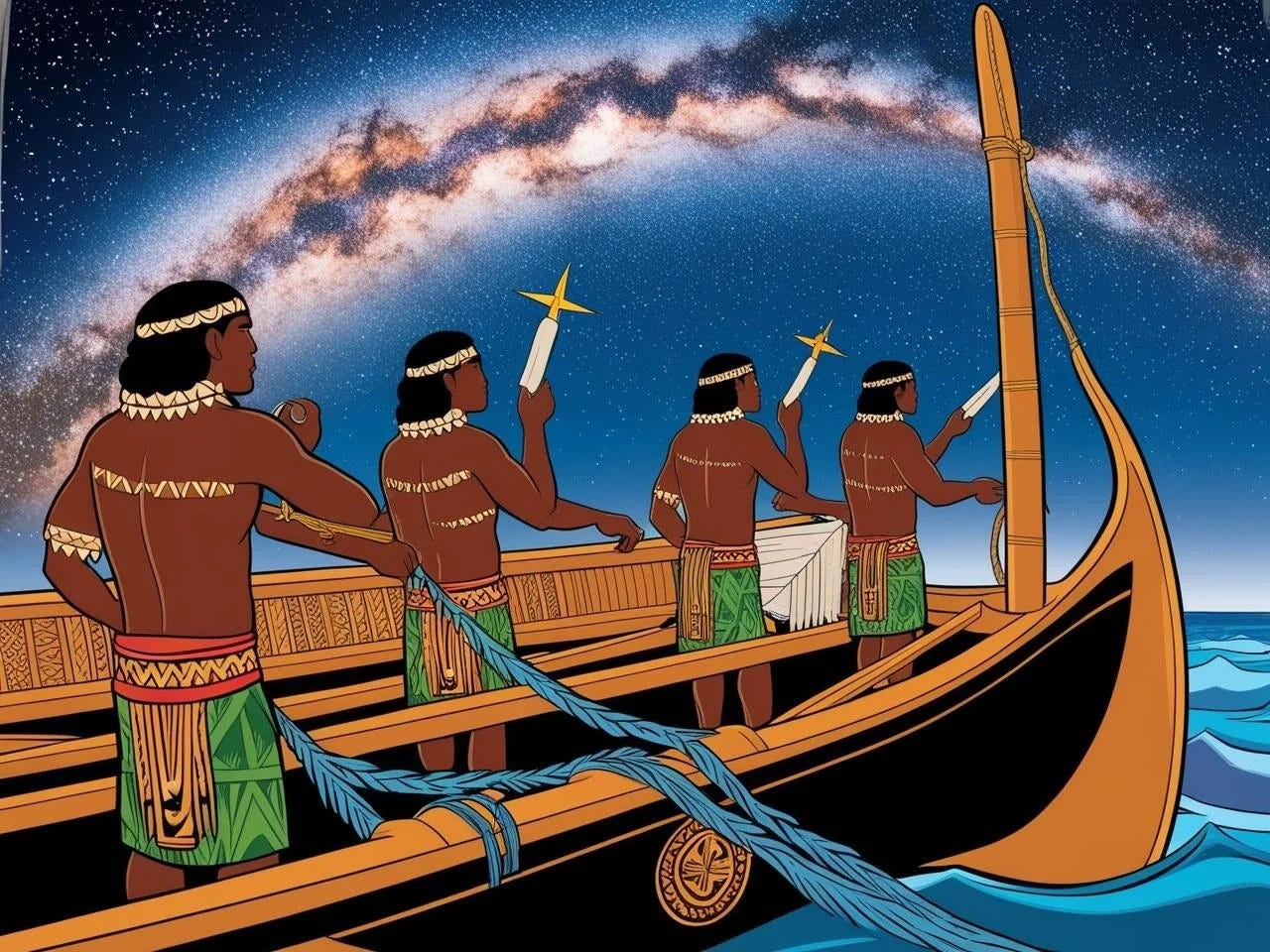
In the open Pacific, master navigators learned the sky by pacing—in this case, along the decks of their canoes.
Their “horizon” was a circle of open sea.
To learn the rising points of stars, navigators:
stood in specific positions on the canoe
memorized star paths relative to rails and lashings
walked the length of the vessel to internalize star bearings
repeated this training night after night
The canoe became a mobile observatory; the navigator became its instrument.
While these practices differ from Puebloan traditions in every cultural respect, they share one essential truth:
The earliest astronomers did not merely look at the sky.
They moved with it.
Why Sky Pacers Matter
Chaco Canyon shows us attention carved into stone.
The Sky Pacers show us attention carried in flesh.
Together, they reveal a two-part truth about early astronomy:
Memory can be monumental (spirals, petroglyphs, architecture)
Memory can be embodied (walking, pacing, returning)
Chaco answers the question: How do you fix the sky in place?
The Sky Pacers answer: How do you walk with it so you don’t lose your way?
And it is only after both forms of knowing coexist—stone memory and body memory—that cultures become capable of noticing something as fleeting and dramatic as SN 1054.
Not because the heavens changed.
But because people had trained themselves to notice change.
What the ancient sky-watchers of Chaco Canyon carved into stone, and what the Sky Pacers carried in their bodies, were not preludes to poetry—they were poetry. Not in letters or lines, but in pattern, memory, return.
Poetry was the act of noticing, repeated until it became knowledge. It was the pacing of the horizon, the waiting for the dagger of light, the willingness to see the sky not as spectacle but as relationship.
… attention shaped into meaning …
Long before astronomy became a science, its foundations were built in this wordless language: attention shaped into meaning. If poetry is, at heart, patterned perception, then the first poems of the sky were not spoken. They were lived.
And yet, this ancient way of listening to the sky did not vanish. It changed shape.

When glass lenses replaced spirals, and ink replaced footpaths, the sky’s meaning migrated into new forms of expression.
Today, some of the most potent echoes of those early, wordless astronomers appear in an unexpected place: modern science-fiction poetry.
It is here—where data meets metaphor, and cosmic scale meets human breath—that the oldest questions return, wearing new language.
In the next essay, we follow that thread forward—to the poets who look through telescopes and still hear the sky the way the ancients once did.
How do you walk with the sky so you don’t lose your way?
This essay is part of the Star Archive Series.
Intro: The Star Archive: How Poetry Saved the Sky
Essay 1: The First Astronomers Were Poets
Essay 2: Dragons in the Sky: When Celestial Events Become Myth
Essay 3: Pictographs and the Poetry That Doesn’t Use Words
Next time …
Essay #5: Where the Telescope Meets the Lyric: Science-Fiction Poetry Today

My brain did that happy little click where wonder puts on a lab coat and goes, okay, let’s be precise now. Attention learning to count without losing its soul? Delicious.
Stone remembering. Bodies remembering. People literally walking the sky into their muscles. That whole idea made me want to look up from my screen and check where the sun is right now. By the end I wasn’t reading an essay anymore — I was being gently recruited into the noticing club, no membership card required.
In The Elements of Eloquence, Mark Forsyth writes, "A poet is somebody who expresses his thoughts, however commonplace they may be, exquisitely." I think you've captured that beautifully here. Sure, we can all look up at the sky, but to inscribe its meaning into stone or carry it as we journey through the world is an exquisite expression of our common, shared human instinct to seek wonder.
Loving this whole series! ✨