


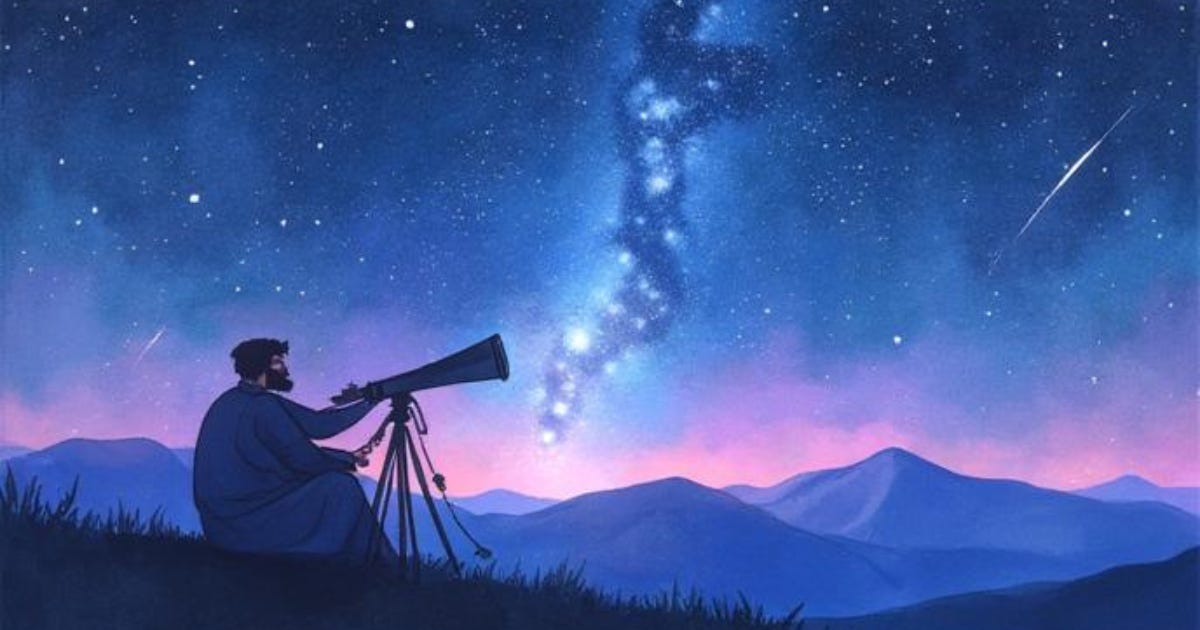
Poetry is not done being scientific.
Through an ancient lens, we have been examining how data once became poetry. We now turn our attention to how old-age cosmic wonder is wearing new language—how poetry meets the sky today.
“From earth, we read the sky as if it is an unerring book of the universe,
expert and evident.”
~Ada Limón, Poet Laureate, A Poem for Europa
Limón’s poem, In Praise of Mystery: A Poem for Europa, is etched upon a spacecraft and on its way to Jupiter’s second moon. A poem … physically leaving Earth.
We seem to be returning to cosmic listening today, though under new constraints.
Are we entering a second golden age of sky-poetry?
Why Poetry Has Returned to the Cosmos
At some juncture, science always reaches a point where it exceeds ordinary language. It requires a specialized vocabulary bent on context-free precision to describe reality objectively, leaving behind everyday ambiguity and emotional connotations.
Dark matter. Quantum gravity. Fast Radio Bursts from distant galaxies. Recognizable words, yes, but meanings that are still being honed.
Poetry has always exceeded ordinary language. It’s not such a strange bedfellow to science as you might imagine.
Science and poetry both rely on metaphor, precision, wonder, experimentation, and observation to find meaning and to explore our existence. They ask the same questions, but perhaps answer them differently.
Where science explicates, pursuing an explanation of how the world and existence work, poetry implicates. It pursues an understanding of how the world and existence feel.
Poetry seamlessly steps in when prose fails.
It makes sense that ancient writings about the sky were poetic. Poetry reaches where ordinary language or prose cannot.
Today, with science moving faster than ever before, it’s no wonder ordinary language cannot keep up. It’s no wonder then, that poets are reaching back to the sky, lending a hand to what there are no words for.
Modern Poets Who Practice Sky-listening
In the previous essay, The Crab’s Claim: Evidence After Attention, we saw how ancient sky-watchers embodied knowledge and fixed it into stone. In today’s terms, the Sun Dagger of Fajada Butte was a telescope of sorts, and the spiral petroglyph a lyric.
Today, instrumentation helps record knowledge as words.
In 2012, Tracy K. Smith earned the Pulitzer Prize for Poetry for her book of poems: Life on Mars. She used science fiction, pop culture (like David Bowie) and space exploration to frame the human experience, grief, and the search for meaning.
She was a child of the astronomer-poet tradition. Her father worked on the Hubble Telescope. She couldn’t help but look to the stars.
In My God, It’s Full of Stars, Smith writes:
The first few pictures came back blurred, and I felt ashamed
For all the cheerful engineers, my father and his tribe. The second time,
The optics jibed. We saw to the edge of all there is—
So brutal and alive it seemed to comprehend us back.
~ Tracy K. Smith, “My God, It’s Full of Stars” from Life on Mars. Copyright © 2011 by Tracy K. Smith.

“We saw to the edge of all there is—”
Smith writes not as someone imagining space, but as someone raised in its making.
Lineage witnessed. A spiral. A handprint. A star.
Rebecca Elson, an Astronomer-Poet
When it comes to modern sky-watchers who truly earn the title Sky Poet, one could hardly look further than Rebecca Elson.
At 16, she saw Andromeda galaxy for the first time and wrote: “delicate wisp of milky spiral light floating in what seemed a bottomless well of empty space.”
At 26, she earned her Ph.D. in astronomy at the University of Cambridge.
At 29, she was diagnosed with cancer.
At 29, she became the youngest astronomer to serve on the National Academy of Sciences (US) decennial review of the field of astronomy.
And at 39, she was returned to the stars from whence she came after losing her final battle with cancer.
A Responsibility to Awe—posthumously published in 2001—the title itself speaks directly to our own Star Archive series.
A book of poems and essays written from the time she was a teen to shortly before her passing.
Rebecca Elson—a “scientist for whom poetry was a necessary aspect of research, crucial to understanding the world and her place in it…”
Elson looked up at the same sky as the Ancient Puebloans in Chaco Canyon. She had the words they did not, but the awe … they undoubtedly shared.
From A Responsibility to Awe by Rebecca Elson:
Forget the clatter of ballistics,
The monologue of falling stones,
The sharp vectors
And the stiff numbered grids.
It’s so much more a thing of pliancy, persuasion,
Where space might cup itself around a planet
Like your palm around a stone,
Where you, yourself the planet,
Caught up in some geodesic dream,
Might wake to feel it enfold your weight
And know there is, in fact, no falling.
It is this, and the existence of limits.
Elson was a thinker who understood science as relationship.
I wonder if Ursula K. Le Guin read her poetry; it seems like a natural alignment.
I wonder of Rebecca Elson ever read Walt Whitman—not a sky-poet—but one who listened and responded when he wrote When I Heard the Learn’d Astronomer:
When I heard the learn’d astronomer,
When the proofs, the figures, were ranged in columns before me,
When I was shown the charts and diagrams, to add, divide, and measure them,
When I sitting heard the astronomer where he lectured with much applause in the lecture-room,
How soon unaccountable I became tired and sick,
Till rising and gliding out I wander’d off by myself,
In the mystical moist night-air, and from time to time,
Look’d up in perfect silence at the stars.
In his poem, Whitman unwittingly reminds us that knowledge or explanation must be answered by attention.
Knowing the universe’s workings is one thing, but understanding its impact on you—how it makes you feel—requires direct experience. You have to go outside and encounter it personally.
Whitman didn’t have access to someone like Rebecca Elson back then. He undoubtedly would have been fascinated by how she remained grounded in science while still keeping that sense of wonder alive.
Elson would not have left the lecture hall;
she would have brought the night air into it.
The data tell us where to look.
The looking completes the knowing.
The first poets wrote the sky down so it wouldn’t be forgotten. Today’s poets write it down so we won’t forget.
Encounter
by jlynn
discovery calls
curiosity keeps time
my dust meets the stars
This essay is part of the Star Archive Series.
Intro: The Star Archive: How Poetry Saved the Sky
Essay 1: The First Astronomers Were Poets
Essay 2: Dragons in the Sky: When Celestial Events Become Myth
Essay 3: Pictographs and the Poetry That Doesn’t Use Words
Essay 4: The Crab’s Claim: Evidence After Attention
Essay 5: Where the Telescope Meets the Lyric: Sky-Poetry Today (you have arrived)
My dust meets the stars ✨ 💖
ahhh this made me feel like my head tilted back without me noticing. numbers and wonder holding hands and staring at the same sky. yes please~
I loved that bit about bringing the night air into the lecture hall. that’s exactly it. data points the way, but looking is where the knowing actually happens. dust meeting stars, brain meeting awe.
this felt nerdy and tender and wide-open all at once. I’m smiling up at it~